Neuroscience of Behaviour
Understanding how the brain, body and nervous system shape thinking, emotions, decisions and behaviour.
A philosophy and methodology for developing human capacity.
Life continually asks more of us.
The Capacity Approach™ explores what enables us to meet life's demands with greater awareness, choice and intention.
It brings together neuroscience, emotional intelligence, coaching and human-centred learning to help people develop the capacity to respond, adapt and grow.
Capability tells us what we can do.
Capacity influences whether we can access it when it matters most.
We all develop ways of thinking, feeling and responding through our experiences, beliefs, habits and relationships.
Over time, these become part of our inner operating system.
As life changes and demands increase, the question is not simply what we know or what we are capable of doing.
It is whether we can access those capabilities when circumstances require us to think differently, regulate ourselves, make difficult choices, connect with others or respond to uncertainty.
Capacity is not fixed or dormant. It can be developed, strengthened and expanded through awareness, reflection, practice and intentional action.
Think of your mind as an inner operating system.
Throughout life, we develop ways of thinking, feeling and responding based on our experiences, beliefs, habits and assumptions.
As life evolves, its demands become more complex. Yet many of us continue responding through an inner operating system organised for an earlier stage of life.
The Capacity Approach™ is not about becoming someone different.
It is about becoming more aware of what is already shaping our responses—and developing the capacity to respond differently when life asks more of us.
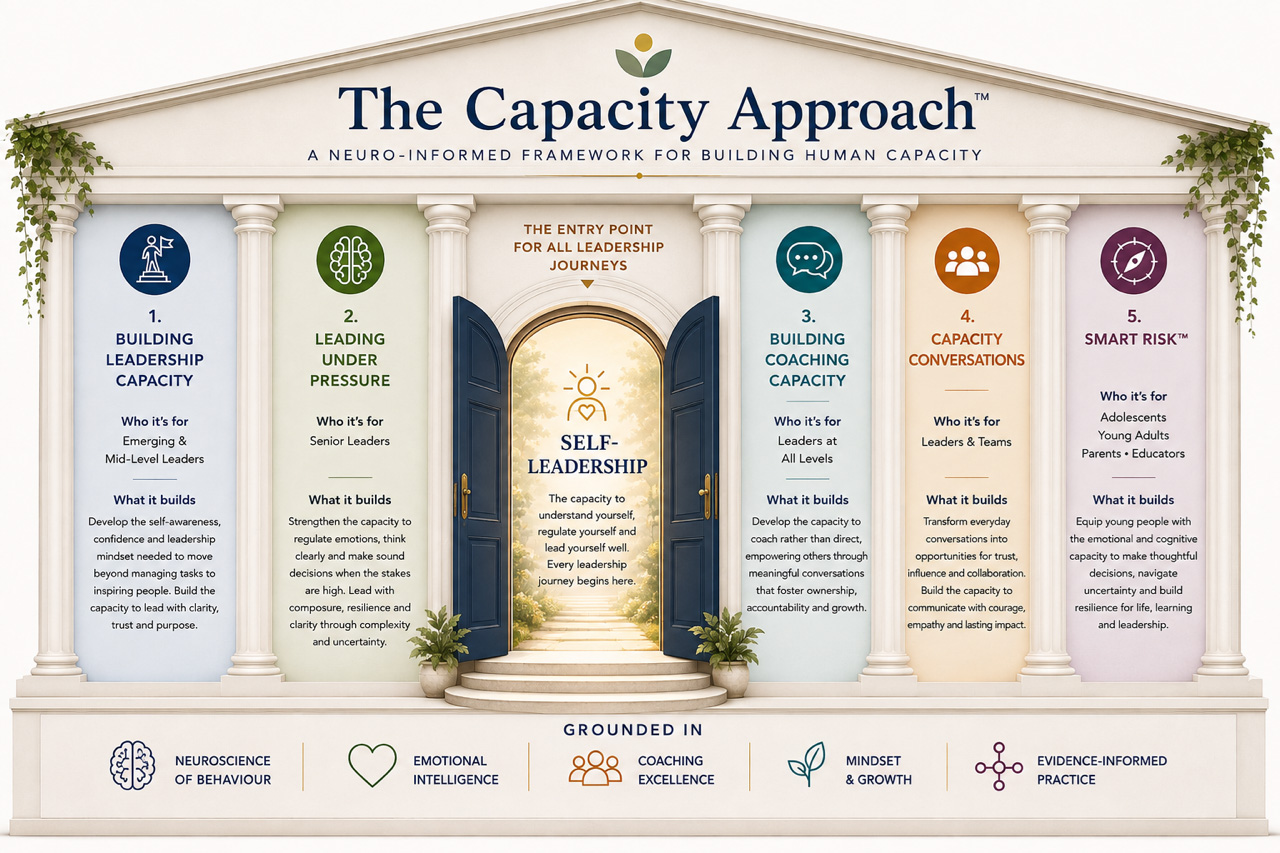
Five pathways. One integrated approach to developing human capacity.
The Capacity Pavilion™ brings The Capacity Approach™ to life.
It represents five pathways through which human capacity can be developed and applied across different contexts.
Self-Leadership is the entry point.
From there, the pathways provide different ways of developing and applying human capacity.
A living sequence—not a rigid formula.
Capacity develops through awareness, reflection, intentional choice, practice and integration.
Capacity development is ongoing and iterative—not a one-time process.
Developing capacity changes not only what we do, but how we meet the demands of life.
Capacity work looks beyond the immediate problem to the patterns, beliefs, emotions and responses that shape how a person engages with life.
A workplace conflict, a leadership challenge, a difficult relationship or a life transition may be what brings someone to the work.
The deeper work is developing the capacity to meet similar situations differently in the future.
The issue may bring someone to the work.
The person they become is what remains.
The Capacity Approach™ is grounded in:
Understanding how the brain, body and nervous system shape thinking, emotions, decisions and behaviour.
Developing awareness and regulation needed to lead oneself and connect effectively with others.
Creating meaningful conversations that strengthen ownership, insight and action.
Building curiosity, adaptability, resilience and willingness to learn through challenge and change.
Grounding the work in research, neuroscience, coaching practice and real-world application.
Capacity develops through the way we meet the demands of life—one experience, one choice and one practice at a time.